
In Texas, both sides pay closing costs, but they pay different things. Buyers usually cover the loan-related charges. Sellers usually cover agent commissions, payoff of any liens or loans, and prorated taxes and dues. Almost everything beyond that is set by the sales contract, so it can be negotiated.
This guide shows who typically pays what, which items you can negotiate, how much to plan for, and how the picture changes if you sell your Texas house for cash.
TL;DR
- Buyers and sellers both pay closing costs in Texas. Buyers pay more individual line items, mostly tied to the mortgage. Sellers often pay the largest single item, the agent commission.
- Who pays a given charge is decided by the contract (the TREC contract’s Paragraph 12 lists the expenses each side agrees to pay), not by a fixed state rule.
- The title policy premium is regulated, but the parties can negotiate who pays it. Escrow, recording and delivery fees vary between title agents, so compare them.
- “No-closing-cost” loans do not erase costs. They usually move them into a higher rate or a larger loan balance.
- A direct cash sale can remove commissions and repair costs from the seller’s side. Title and closing charges still exist, so ask for the numbers in writing.
Table of Contents
- The short answer: it depends on the contract
- What buyers usually pay
- What sellers usually pay
- Side-by-side: who typically pays what
- How the new TREC contract treats seller contributions
- Title insurance: regulated price, flexible payer
- How much should you plan for?
- When are closing costs actually due?
- Can closing costs be rolled into a loan?
- Ways to lower closing costs in Texas
- How selling for cash changes the seller’s costs
- Sell your Edinburg house for cash
- Our perspective
- FAQ
- Sources
The short answer: it depends on the contract
Texas has no single rule that says “the buyer pays” or “the seller pays.” The Texas Real Estate Commission (TREC) explains that the contract’s Paragraph 12 lists the settlement and other expenses the seller and buyer each agree to pay at or before closing, with seller and buyer expenses listed separately. A title company’s reference guide says the same thing in plain terms: every item is negotiable in the TREC contract, and actual responsibility is governed by the contract and the particular transaction.
So the customs below are the starting point most Texas deals follow. Your own contract is what counts.
What buyers usually pay
Buyer costs cluster around financing and protecting the buyer’s own interest in the property. A Texas title company’s guide lists these typical buyer items: escrow fees, document preparation, recording charges, prorated taxes, new-loan charges, the lender’s title policy, interest and first-year fire insurance. A mortgage lender’s Texas overview adds appraisal, inspection, title search, notary fees and mortgage points to the buyer’s usual list.
Another title company guide notes that buyers normally pay half the escrow fee, according to contract, plus interim interest from funding to the first payment date.
In practice, a financed buyer’s list looks like this:
- Loan origination and other lender charges
- Appraisal
- Home inspection
- Lender’s title policy
- Prepaid items such as homeowners insurance and interest
- Recording charges for documents in the buyer’s name
- Half of the escrow fee, when the contract splits it
What sellers usually pay
Seller costs mostly come out of the sale proceeds. The same Texas title company guide lists the customary seller items: agreed brokerage compensation, payoff of seller loans and release charges, seller liens and judgments, delinquent taxes, unpaid HOA dues, seller-side recording charges, the owner’s title policy, and any agreed seller credit.
The mortgage lender overview also lists prorated taxes and HOA fees, deed preparation and recording, mortgages and liens, attorney fees and concessions among the items sellers may pay.
For most sellers, three things dominate:
- Commission. This is usually the biggest line.
- Mortgage payoff and liens. Not a “cost” in the usual sense, but it comes off the top.
- Owner’s title policy. Commonly a seller expense in Texas, though negotiable.
Side-by-side: who typically pays what
| Item | Usually paid by | Negotiable? |
|---|---|---|
| Agent commission | Seller | Yes |
| Seller contribution toward buyer’s costs | Seller (if agreed) | Yes |
| Owner’s title policy | Seller | Yes |
| Lender’s title policy | Buyer | Yes |
| Loan charges, points, interest | Buyer | Lender terms apply |
| Appraisal and inspection | Buyer | By contract |
| Escrow fee | Split, per contract | Yes |
| Prorated property taxes | Each side for its own period | Per contract |
| Unpaid HOA dues, delinquent taxes | Seller | No, must be cleared |
| Seller’s mortgage payoff and liens | Seller | No, must be cleared |
| Recording charges | Each for its own documents | Per contract |
How the new TREC contract treats seller contributions
TREC’s current contract separates two kinds of seller help. One is a seller contribution toward buyer-broker compensation. The other is a seller contribution toward the buyer’s other expenses. TREC says a contribution toward buyer-broker fees is limited to the lesser of the stated amount or the buyer’s actual agreed broker obligation.
For a seller, that means a concession is no longer a vague lump sum. You can see what you are offering for agent compensation and what you are offering toward the buyer’s other costs.
Title insurance: regulated price, flexible payer
Title fees are a frequent point of confusion. The Texas Department of Insurance (TDI) says the title policy premium is paid once at closing and the parties may negotiate who pays it. TDI also says all title companies charge the same premium for the same policy and property value, because the rate is set by the state.
The current rate table, effective March 1, 2026, lists a $780 basic premium for a $100,000 policy. Amounts above $100,000 follow a published graduated formula, so check the table for your price.
When both an owner’s and a lender’s policy are issued at the same time, Texas practice commonly uses a discounted simultaneous-issue charge. Who pays each policy still depends on the contract.
The premium is fixed, but other charges are not. TDI advises reviewing and comparing variable extra charges such as escrow, tax certificate, recording and delivery fees, because they differ between title agents. That is a real place to save money on either side.
How much should you plan for?
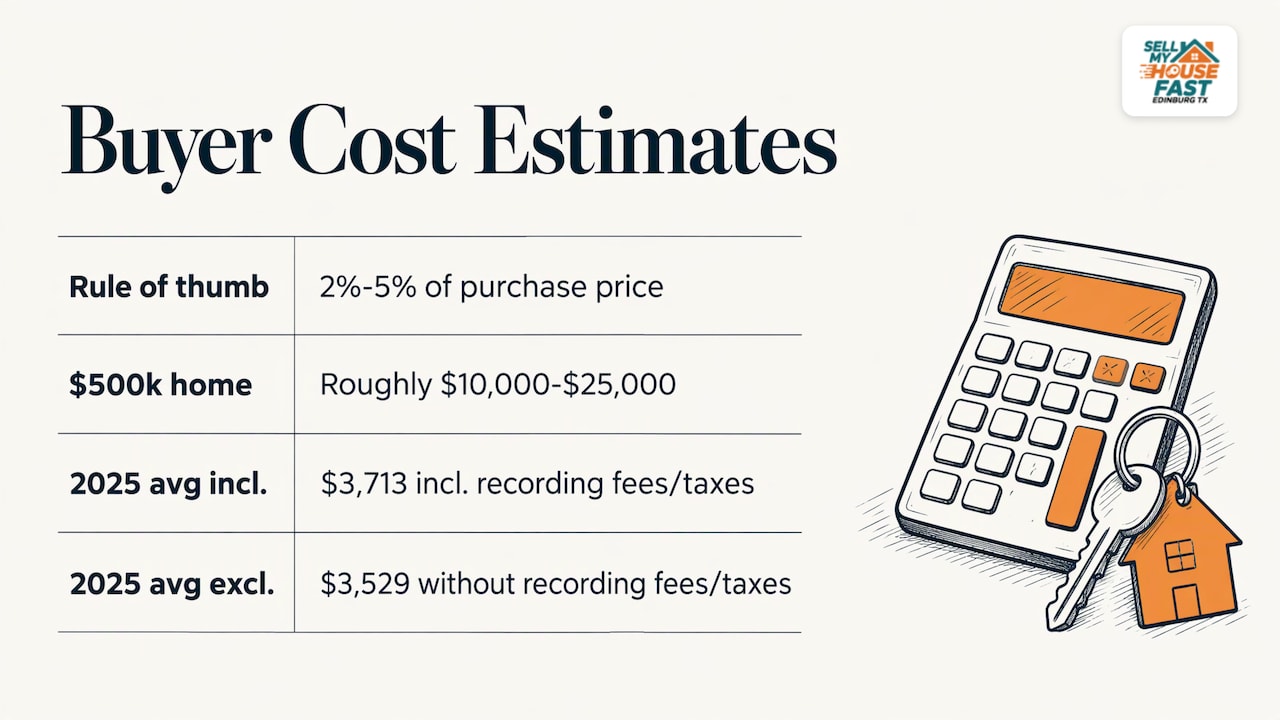
A common rule of thumb for Texas buyers is 2% to 5% of the purchase price, which excludes the down payment. On a $500,000 home, that works out to roughly $10,000 to $25,000. The spread is wide because the amount depends on price, loan type, and what the parties negotiate.
A lender’s analysis of 2025 data puts the average Texas buyer figure at $3,713 including recording fees and taxes, or $3,529 without them. That average covers fees tied to the transaction itself, so it will look lower than the rule of thumb, which typically includes prepaids such as insurance and escrowed taxes.
Sellers should budget separately. If you pay a commission, it will usually exceed every other seller cost combined. Add the owner’s title policy, any contribution you agreed to, prorated taxes, and any lien or HOA balance.
When are closing costs actually due?
Not everything is paid at the closing table. Appraisal and inspection fees are often paid when the service is done. The buyer also deposits earnest money early: one title company’s buyer guide says the buyer has three days after the contract is signed to deposit earnest money with the escrow agent or title company.
At closing, buyers send funds to the title company, and the escrow agent closes the transaction, disburses funds and records the deed. For financed purchases, federal rules generally require the lender to deliver the Closing Disclosure at least three business days before closing, so you see final numbers before you sign. Seller costs are deducted from proceeds at closing, so sellers rarely write a check.
Can closing costs be rolled into a loan?
Sometimes, but not automatically. According to a mortgage lender’s guide by loan type, conventional purchase loans generally do not simply add all closing costs to the loan. FHA commonly permits financing the upfront mortgage-insurance premium, VA commonly permits financing the funding fee, and USDA may allow eligible costs when the appraisal supports a higher loan. Seller credits, lender credits, gifts or assistance can instead reduce the cash due, within program and lender limits.
The Consumer Financial Protection Bureau (CFPB) explains that a lender’s “no-closing-cost” offer usually means the costs are covered by a higher interest rate or added to the loan balance, not eliminated. Treat credits as a cash-flow tool: they lower what you owe at the table, not the total cost of the deal.
Ways to lower closing costs in Texas
- Compare title agents’ extra charges. The premium is the same everywhere, but escrow, recording and delivery fees are not.
- Negotiate who pays the title policy. TDI confirms this is open to agreement.
- Ask for a seller credit. Buyers can request one in the offer; sellers can decide whether it is worth it to close the deal.
- Compare lender offers. Look at the rate and the fees together, not just one.
- Time the closing. Prorated items and interim interest change with the closing date.
How selling for cash changes the seller’s costs
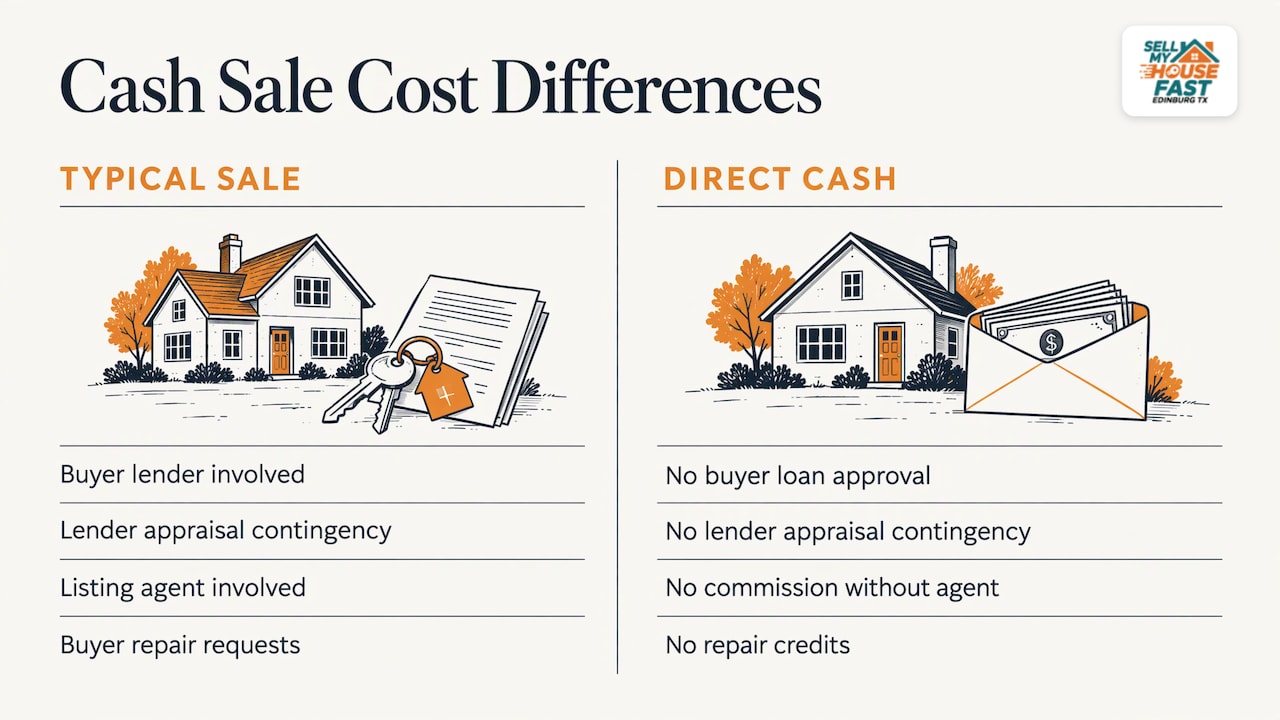
Most of the seller costs above exist because a typical sale involves a listing agent, a buyer’s lender and a buyer’s repair requests. A direct cash purchase removes several of those pieces. There is no buyer loan to approve, no appraisal contingency from a lender, and no commission when you sell straight to the buyer without an agent.
That does not make every cost vanish. If you owe a mortgage, tax or HOA balance, it is still paid from the proceeds. Title work still happens at a title company. The difference is in what you add on top: no agent fee, no repair credits, no cleaning, and no months of carrying costs while you wait for a financed buyer. If you want to see how the math compares, our guide to selling a house as-is and what you net walks through it, and our page on what makes a cash offer fair helps you judge any offer you receive.
If the house needs work, the numbers shift further. Repair concessions and price cuts are among the most common ways sellers end up paying more than expected, which is why homes with issues like foundation problems in Texas are often better sold as-is. If you are weighing a sale without an agent, see how to sell a home without a realtor for the real options.
Sell your Edinburg house for cash
If you own a house or land in Edinburg, TX and want a sale without commissions, repairs or showings, we can help. We make direct cash offers based on local market values, take properties as-is, handle the paperwork and closing process, and let you choose the timeline. Closing can happen in as little as seven days.

To see how it works, read how our process works, or request a cash offer for your Edinburg house. If you own vacant acreage, we also buy land in Edinburg.
Our perspective
Most Texas sellers we talk to are not surprised by the commission. They are surprised by everything around it: repair requests after the inspection, credits to keep a buyer’s loan on track, and the months of mortgage, tax and utility payments while the house sits.
That is why we built our approach around removing steps. We buy houses and land in Edinburg directly, in any condition, with no agent involved and no commissions or fees on our side. We evaluate the property against local market value and explain the offer plainly, so you know what you are agreeing to.
Closing costs should never be a mystery. Whatever route you choose, ask for a written estimate of what you will pay and what you will receive. If a quick, as-is sale fits your situation, whether the home is inherited, vacant, outdated or needs major repairs, you choose the timeline, and we handle the paperwork and closing process.
Wally
FAQ
Does the buyer or seller pay closing costs in Texas?
Both do. Buyers typically pay loan, appraisal, inspection and lender title policy costs, while sellers typically pay the commission, liens, prorated taxes and dues, and often the owner’s title policy. The final split is set in the contract and can be negotiated.
Who pays title fees in Texas?
The title policy premium is regulated, and TDI says the buyer and seller may negotiate who pays it. In many Texas deals the seller pays for the owner’s policy and the buyer pays for the lender’s policy. Extra charges like escrow and recording fees vary by title agent.
Can a seller pay the buyer’s closing costs?
Yes, if the contract provides for it. TREC’s current contract separates a seller contribution toward buyer-broker compensation from a contribution toward other buyer expenses. Loan programs may limit how much a seller can contribute.
Are closing costs included in the loan?
Not usually in full. Some programs let buyers finance specific items, such as FHA’s upfront mortgage-insurance premium or the VA funding fee. A “no-closing-cost” loan typically means a higher rate or a larger balance, according to the CFPB.
Do I pay closing costs if I sell my house for cash?
You may still have title and settlement charges, and any mortgage, tax or HOA balance is paid from proceeds. A direct cash sale can remove commissions and repair costs. Ask for the full cost breakdown before you sign.
Sources
- TREC: Clearing Up Compensation Confusion
- Texas Department of Insurance: Title insurance FAQ
- Texas Department of Insurance: Title insurance basic premium rates
- Consumer Financial Protection Bureau: Get to know loan costs
- Rocket Mortgage: Average closing costs in Texas
- Old Republic Title: Who pays for what
- Austin Title: Closing fee reference guide
- Texas First: Who pays for what
- JVM Lending: Who pays title insurance in Texas
- Lower Mortgage: Closing costs by loan type
- Republic Title: Home buyer’s guide
- Texas National Title: Buyer’s handbook