
Selling a house to pay off debt works when the sale price covers your mortgage, any liens and the cost of selling, and still leaves enough to clear what you owe. If that math holds, a sale can end the debt in one closing. A direct cash sale in Edinburg, TX keeps the costs on your side of the ledger low, because there are no agent commissions, no repairs and no showings. We buy houses and land in Edinburg for cash, and you choose the timeline. This guide shows how to run the numbers before you decide.
TL;DR
- A sale pays off debt only if the price exceeds your mortgage payoff, liens and selling costs. Do the net-proceeds math first.
- Traditional selling costs often reach 8% to 10% of the sale price. Selling for cash directly to a buyer with no agent and no fees keeps more of your equity.
- Selling usually makes sense when the mortgage itself is the problem, when you face foreclosure, or when you already planned to move. It does not fix spending habits.
- If the sale won’t cover the mortgage, talk to your lender and a HUD-approved housing counselor before you sign anything.
- Inherited and run-down houses can be sold as-is, so the repair bill doesn’t eat the proceeds.
Table of Contents
- When selling your house to pay off debt makes sense
- Do you have to sell? What Texas law says about creditors
- How to estimate what you would actually keep
- Where the selling costs go
- If the sale won’t cover what you owe
- Inherited and run-down houses: selling as-is
- Plan where you will live after the sale
- Our perspective
- Get a cash offer on your Edinburg house
- FAQ
- Sources
When selling your house to pay off debt makes sense
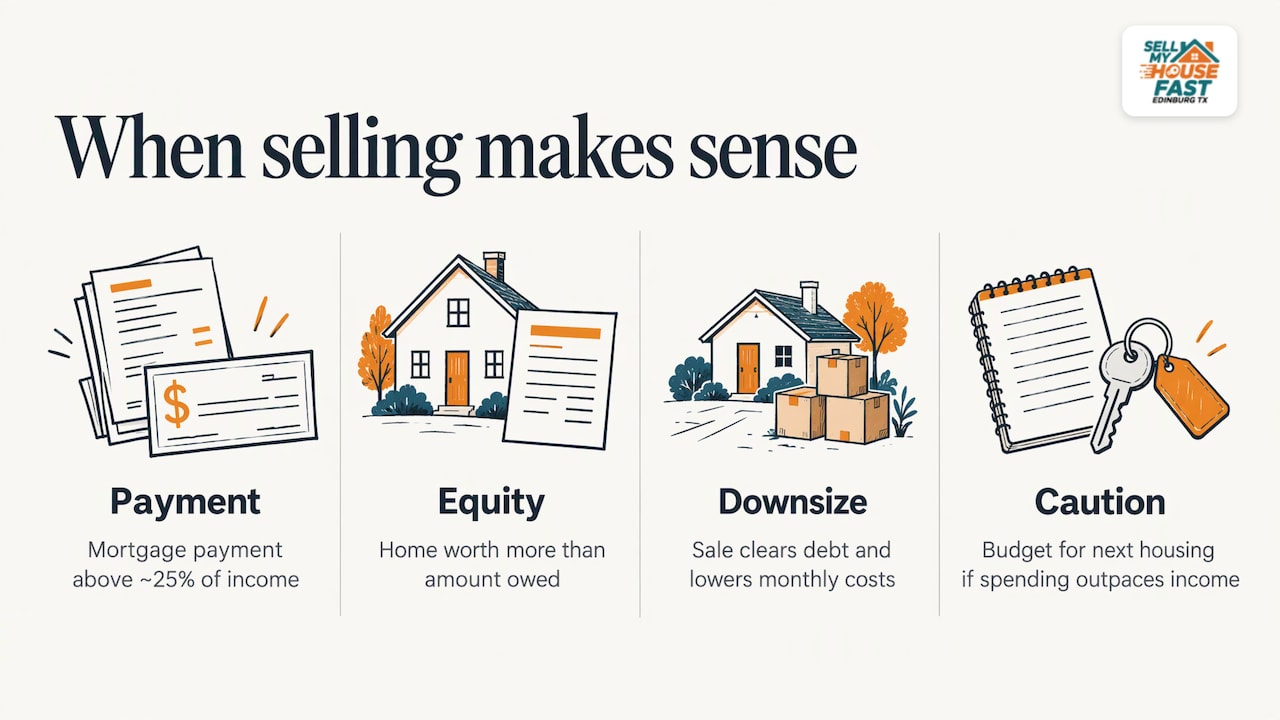
A house is often the largest asset a family owns, so it is natural to ask whether it should clear the debts. Three situations make the answer yes.
The mortgage is the debt that is hurting you. U.S. News lists struggling to afford the payments as a reason to sell, because it avoids the credit damage of foreclosure. Ramsey Solutions puts a number on it: a mortgage payment above roughly 25% of your income is a sign the house is too expensive to make progress in.
You have real equity. Equity is the sale price minus what you owe on the house. The Consumer Financial Protection Bureau (CFPB), the federal agency that oversees mortgage lenders, says selling is typically better for your money and credit than foreclosure, a short sale or a deed-in-lieu when the home is worth more than you owe.
You can move to cheaper housing. If you were already planning to downsize or relocate, the sale does two jobs at once: it clears debt and lowers your monthly costs.
One caution applies to everyone. If your debt came from spending that outpaces income, a sale clears the balance but not the habit. Pair the sale with a budget for where you will live next.
Do you have to sell? What Texas law says about creditors
In Texas, most credit card, medical and personal loan creditors cannot force you to sell your primary residence. According to a summary of the Texas homestead rules, the state constitution bars forced sale of a homestead for almost all debts, with a narrow list of exceptions such as purchase-money loans, property taxes and properly made home equity loans.
That means selling is usually your choice, not a creditor’s demand. It also means the decision should rest on whether the sale improves your finances, not on pressure from collection letters.
Two things can still reach the house:
- Secured debts. The mortgage, a home equity loan and unpaid property taxes are tied to the property itself. If you are behind on taxes, see our guide to selling property with unpaid taxes.
- Recorded judgment liens. A lien recorded against your property after a court judgment can come up at closing. A Texas law firm describes how a judgment lien surfaced in a title search days before a closing and halted it. The title company will list any such lien, and it is normally paid from your proceeds at closing.
How to estimate what you would actually keep
The number that matters is not the sale price. It is the cash left after everything is paid. Here is the routine.
- Estimate the sale price. A cash offer based on local market values gives you a real figure to work with instead of a guess.
- Get a payoff quote from your lender. The payoff is not the same as the balance on your statement. A payoff statement adds interest through the payoff date and release charges, and the difference can reach four figures on a large loan.
- List every lien. Second mortgages, home equity loans, tax liens, mechanic’s liens and overdue HOA dues must be paid before closing and can typically be paid from the proceeds. Ask each holder for a dated payoff quote, since valid-through dates and daily interest change the figure.
- Subtract the selling costs. This is where a traditional sale and a direct sale differ most (see the next section).
- Add in the costs people forget. Paint, repairs, staging and moving costs do not show up in a closing-cash figure but they come out of your pocket.
- Check taxes. U.S. homeowners can generally exclude up to $250,000 of gain on a primary residence, or $500,000 for married couples filing jointly. Gains above that, or on a home that wasn’t your primary residence, can be taxed. Ask a tax professional about your own situation.
A worked example
Say a house sells for $200,000. Your mortgage payoff is $140,000 and you owe $25,000 across credit cards and a personal loan.
| Line | Traditional listing | Direct cash sale |
|---|---|---|
| Sale price | $200,000 | $200,000 |
| Mortgage payoff | -$140,000 | -$140,000 |
| Agent commissions and typical selling costs (8% to 10% assumed) | -$16,000 to -$20,000 | $0 in commissions and fees |
| Repairs and prep before listing | extra, varies | none needed |
| Left before other debts | $40,000 to $44,000 | $60,000 |
| After paying the $25,000 in other debts | $15,000 to $19,000 | $35,000 |
The figures are an illustration, not an offer: your price, payoff and closing items will differ, and an actual offer depends on your property. The point is that the cost line decides how much of your equity survives the sale.
Where the selling costs go
The cost line is the one you control most. Veterans United itemizes it: listing-agent and buyer-agent compensation typically total 5% to 6%, closing costs add 2% to 4% (title insurance, escrow, transfer taxes, prorated property taxes, HOA fees, and attorney fees where required), and total selling costs often reach 8% to 10% of the price. If you want to understand what that commission pays for, here is what a listing agent does for home sellers.
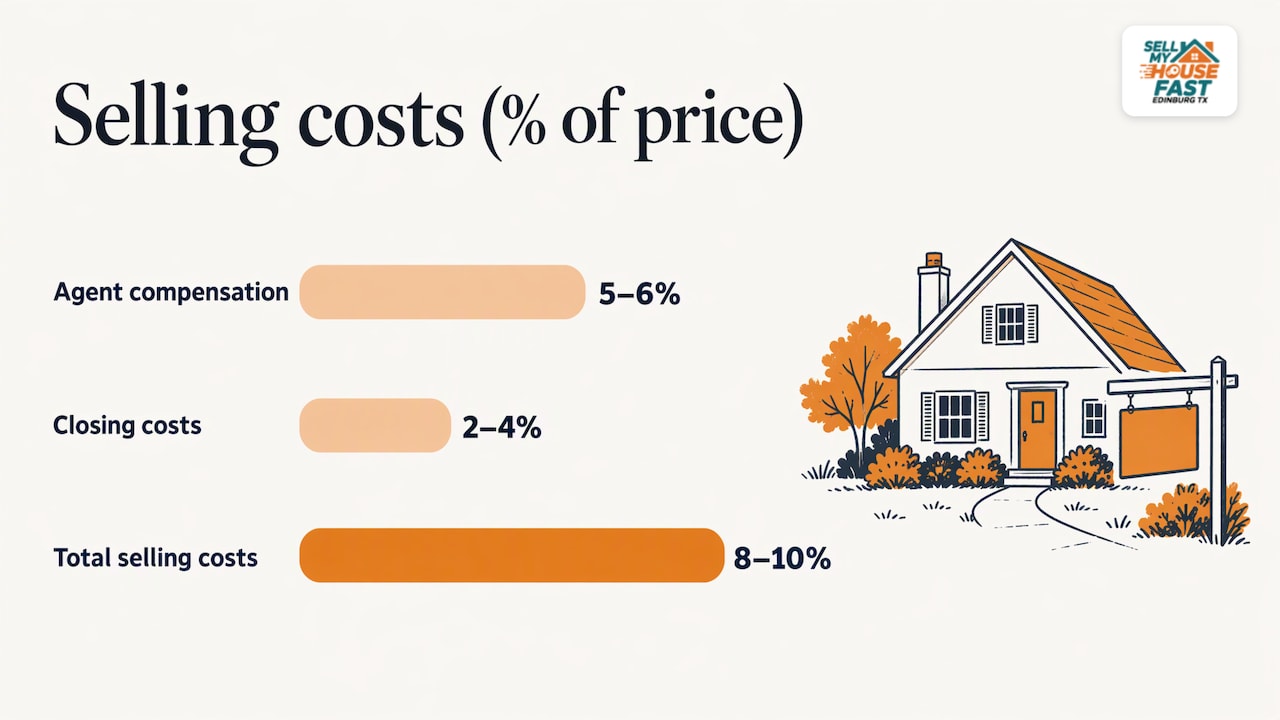
On a $200,000 house, that is $16,000 to $20,000 before you pay a dollar toward your debts. And a listing means months of showings, plus the mortgage, taxes and utilities that keep running while you wait for a buyer.
With a direct cash purchase from us, there is no agent involvement and no commissions or fees. You don’t clean, repair or stage. We handle the paperwork and closing process. If you want to see how closing costs work in Texas, read who pays closing costs in Texas.
If the sale won’t cover what you owe
If your payoff plus liens exceeds the likely price, you are underwater. As U.S. News puts it, a sale won’t produce the funds you need in that case, so slow down and get help before you list or sign.
Here is what to do:
- Call your mortgage servicer. To sell for less than you owe, you need the lender’s agreement. The CFPB explains that with a short sale you may be able to sell for less than your balance.
- Ask about the leftover balance in writing. In states where you can be held responsible for a deficiency (the gap between the sale and the loan balance), the CFPB advises asking the lender to waive it before the sale and getting that waiver in writing, since the lender could otherwise sue to collect.
- Call a HUD-approved housing counselor. The counselors are free, and the CFPB points borrowers to the HOPE Hotline at (888) 995-HOPE (4673), open 24/7.
- Know the alternatives to a sale. The CFPB lists short sales, deed-in-lieu (handing ownership to the servicer) and housing counseling as options before foreclosure. A short sale needs servicer and loan-owner approval through a loss mitigation application, and approval from other mortgage holders if there are several.
If you are already behind, our guide to what to do when you’re behind on your mortgage walks through the options and next steps. If a foreclosure notice has arrived, read selling a foreclosed house for your options and deadlines. You can also contact us to learn what an offer on your house would look like, so you can compare it with your payoff.
Inherited and run-down houses: selling as-is
Many of the homeowners we talk to are not choosing between a nice house and a debt. They hold a house that costs money: an inherited property, a vacant one, or one that needs work.
For inherited homes, a few facts shape the decision:
- Title comes first. Fidelity notes that the house isn’t legally yours until title transfers, and an executor may need to sell an inherited house to pay the estate’s creditors. Many loans also carry due-on-sale clauses that require the full balance to be paid before resale.
- Costs keep running. Kiplinger advises heirs to total taxes, insurance, mortgage, utilities and repairs that continue while the estate is settled, and to check for mortgages and liens.
- Co-heirs need a written plan. Heirs can sell and split net proceeds by ownership share, have one heir buy out the others on an independent appraisal, or keep the house jointly under a written agreement. Kiplinger also notes that a partition proceeding can lead to a court-ordered sale under state law.
- Talk to an estate attorney and a tax professional before you sign, especially if there are several heirs.
For homes that need repairs, a traditional sale often means paying for fixes first, or accepting a lower price. A cash purchase takes the house as-is, so repair estimates do not reduce your proceeds and you skip the cleanup. This also holds for vacant and outdated homes.
If you own land rather than a house, we buy that too: see selling land fast in Edinburg, TX.
Plan where you will live after the sale
A sale that clears debt but leaves you without a place to live only moves the problem. Before you accept an offer, plan these four things:
- Set a housing budget. Ramsey Solutions’ rule of thumb is to keep housing near or under 25% of your income, which leaves room to build savings.
- Choose your closing date around your move. We can close in as little as seven days, and you choose the timeline, so you can move on your schedule instead of the buyer’s. For what is realistic, see how to sell a house in 7 days.
- Set aside money for the move and a deposit. Moving costs come out of your proceeds, so include them in your net figure.
- Decide what the leftover cash does. Pay the highest-interest debt first, then keep an emergency fund so the debt does not return.
If you receive income-based benefits, a lump sum can affect eligibility. UK Citizens Advice warns of this effect for benefits in the UK; in the U.S., ask your benefits office or a housing counselor how sale proceeds count before closing.
Our perspective
We buy houses in Edinburg, and most people who call us are not looking for a bargain on their life. They are tired. A repair list they can’t afford, an inherited house they never planned to own, a mortgage that has outgrown the budget.
Our view is simple: when debt is the problem, the cost of selling should not become a second problem. That is why we buy for cash with no agent, no commissions or fees, and no repairs or cleanup. We base the offer on local market values and explain the evaluation, so you can compare it with your payoff and see what you would keep.
You choose the timeline. Some owners need to close in as little as seven days. Others need time to find a place to live. We handle the paperwork and the closing process either way.
Run your numbers first. If a sale clears what you owe and leaves you a fresh start, we are glad to help you get there.
Wally
Get a cash offer on your Edinburg house
If your numbers say a sale could clear your debt, the next step is seeing what you would be offered. We buy houses and land in Edinburg, TX directly for cash: inherited, vacant, outdated or in need of repairs, with no agent and no fees, and with paperwork and closing handled for you. Start at Sell Your House Fast in Edinburg, TX or request your offer on our cash offer page.

If you want to see the steps first, our how it works page explains the process from offer to closing.
FAQ
Is it a good idea to sell a house to pay off debt?
It is a good idea when the sale price covers your mortgage payoff, liens and costs and still leaves enough to clear your debts, or when the mortgage itself is unaffordable. It is less useful if the debt comes from ongoing overspending, since the habit remains after the house is gone. Work out your net proceeds before deciding.
Do I have to sell my house if I owe credit card or medical debt in Texas?
Generally no. Texas homestead protection bars forced sale of a primary residence for almost all debts, with exceptions such as purchase-money loans, property taxes and certain home equity loans. Selling is therefore usually your choice. A Texas attorney can confirm how this applies to your case.
How much money will I have left after I sell?
Subtract your mortgage payoff, any liens and your selling costs from the sale price. With a traditional sale, selling costs often reach 8% to 10% of the price. With a direct cash sale from us there are no commissions or fees, so the main deductions are your payoff and any liens.
What if I owe more than the house is worth?
You need your lender’s agreement to sell for less than the balance, which is a short sale. Ask the lender in writing to waive any deficiency, and contact a HUD-approved housing counselor, who is free, through the CFPB’s guidance.
Sources
- Should I Sell My Home to Pay Off Debt? (U.S. News)
- Avoid foreclosure (Consumer Financial Protection Bureau)
- What is a short sale? (Consumer Financial Protection Bureau)
- Home Sale Proceeds Calculator (Veterans United)
- Seller net proceeds (Logeora)
- Las Vegas Seller Net Proceeds Calculator (Milvado Realty)
- Inheriting a house and mortgage (Fidelity)
- What Happens When You Inherit a House With Your Siblings (Kiplinger)
- Texas Homestead Protection: Exemptions and Rules
- Texas Judgment Liens on Real Property
- Selling your property to help pay off your mortgage debts (Citizens Advice)