
Yes, you can sell a house with mold. No federal or state law directly prohibits selling a property with a known mold problem, but hiding it is where sellers get into trouble. In Texas you disclose what you know, then choose one of three routes: fix it first, offer the buyer a credit, or sell as-is to a buyer who takes the house in its current condition. We buy houses in Edinburg, TX for cash in any condition, so we see all three routes play out.
TL;DR
- Selling a moldy house is legal. Concealing known mold is what creates liability, including rescission of the sale and fraud claims.
- In Texas, known mold goes on the Seller’s Disclosure Notice, and a mold remediation certificate from the past five years must be handed over too.
- Buyers often react to mold with deep discounts or by walking away, so a financed listing can stall even when the repair is modest.
- Your options: remediate and list, give a credit, or sell as-is for cash and skip repairs, showings and agent commissions.
- Whatever you choose, fix or document the moisture source. Mold without a water fix comes back.
Table of Contents
- Why mold changes a sale
- What Texas sellers must disclose
- Your three options
- What happens when a buyer’s inspection finds mold
- Should you inspect before selling?
- Fix the water first
- Health: why mold is not just cosmetic
- Our perspective
- Selling to us instead of listing
- A practical checklist before you decide
- FAQ
- Sources
Why mold changes a sale
Mold spooks buyers more than its repair bill justifies. One estimate says up to 50% of bidders walk away after learning about a mold infestation, even a remediated one, and that resale value dropped an average of 20% to 37% for minor and major mold problems. Those are national figures, and your house may land well above or below them.
A remediation company commented that visible mold tends to draw lowball offers far above the real repair cost, because buyers price in their worst-case fear. That matches what sellers describe: the invoice for the cleanup is one number, and the discount a nervous buyer asks for is another.
There is also a practical financing angle. One California guide says FHA and VA loans will not fund with visible mold present. Loan rules differ by lender and situation, so ask a lender about your own case. But it shows why a traditional listing can slow down when a buyer relies on a mortgage.
What Texas sellers must disclose
Texas runs mold disclosure through two hooks. The first is the Seller’s Disclosure Notice under Property Code §5.008, which asks for known material defects. The second is a requirement to provide any Certificate of Mold Remediation issued in the past five years under Occupations Code §1958.154, as explained by a Houston mold testing company. That source also notes the standard TREC resale contract builds this in.
The general principle holds across the country. A professional law-firm explanation says a material fact is a defect that significantly affects a property’s value, desirability or safety, and that sellers who know about mold, whether visible, suspected or previously remediated, must disclose it.
What counts as known mold
If you have seen it, smelled it, been told about it, or paid for a past cleanup, treat it as known. A law firm’s guide to Florida’s rules (the principle carries over) says a seller who knows mold is growing behind walls, in ductwork or under flooring must disclose it. A past remediation should be disclosed along with what was done and any structural repairs that followed.
What happens if you conceal it
A buyer who finds mold after closing can pursue rescission or a price reduction, repair and remediation damages, health-injury damages, and fraud claims when a seller actively hid the problem, for example by lying about water damage history. Painting over a stain is the classic example of concealment.
Selling as-is does not erase the duty either. In Pennsylvania, for instance, as-is sales do not eliminate disclosure obligations. Treat Texas the same way: as-is describes the price and repair terms, not your honesty obligations. If you are unsure what a line on the form requires, ask a Texas real estate attorney before you sign it.
Your three options
| Route | Best when | What you do | Watch for |
|---|---|---|---|
| Remediate, then list | Mold is contained and the house is otherwise in good shape | Hire licensed pros, fix the moisture, get a clearance report | Time and upfront cost before you can list |
| List with a credit or price cut | You want a traditional buyer but cannot or will not repair | Disclose, then negotiate a credit | Buyers may ask for more than the repair costs |
| Sell as-is for cash | You need speed, the damage is bigger, or the house needs other work | Disclose, accept an offer, close on your date | Offers reflect the home’s condition |
Option 1: Remediate before listing
One remediation company argues that spending roughly $2,000 to $5,000 to clear a contained problem usually beats the larger discount buyers demand. That is a company opinion, but the logic is sound for small, simple cases.
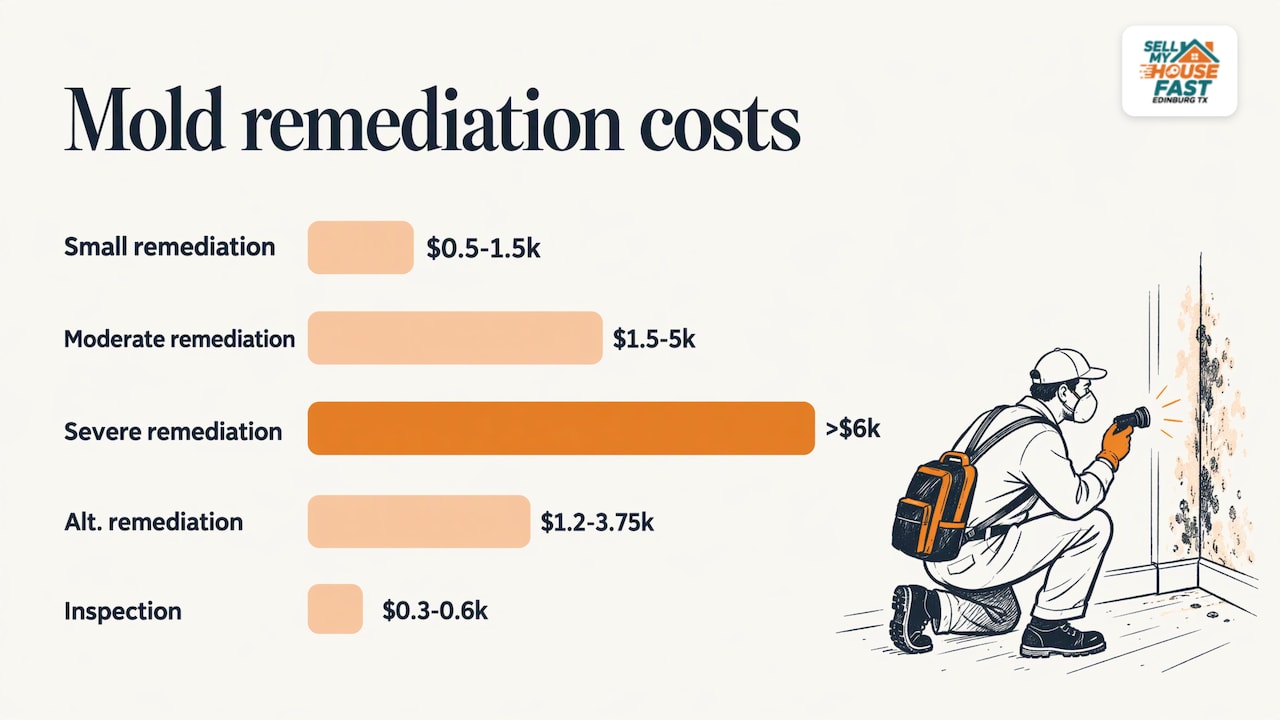
Costs vary by size. A home-services guide puts U.S. remediation at $500 to $1,500 for small areas and $1,500 to $5,000 for moderate infestations, with severe cases involving several rooms or HVAC systems above $6,000. Another source lists typical independent inspection at $300 to $600 and professional remediation at $1,200 to $3,750 for most homes, and says the assessor should not be the remediator.
In Texas, licensing matters. The state’s licensing agency says contractors who assess or remove mold must be properly licensed, and that visible mold under 25 contiguous square feet can often be cleaned by unlicensed people, with some exemptions. Check the agency’s page for how that applies to your house before hiring or doing the work yourself.
The EPA draws a different line for DIY work: if the moldy area is less than about 10 square feet, a homeowner can usually handle cleanup, and larger areas call for its remediation guide. The same page says porous materials such as ceiling tiles and carpet may have to be thrown away, and that you should not run an HVAC system you know or suspect is contaminated.
Option 2: Offer a credit or a lower price
A credit lowers the price and lets the buyer run the repair, but the buyer still needs the funds to complete it. If you refuse, the buyer can take the house as-is or walk.
In practice, credits tend to exceed the repair quote. One Los Angeles agency says a buyer typically asks for 1.5x to 2x the estimated cost, so a $5,000 quote could become an $8,000 to $12,000 ask. That is one local firm’s rule of thumb, but it shows how fear inflates the number.
Option 3: Sell as-is to a cash buyer
This route skips the repair bill, the listing prep and the strangers walking through the house. It is the one we offer. We buy houses in Edinburg, TX for cash, including as-is properties, with no agent commissions, no fees and no repairs or cleanup on your end.
What happens when a buyer’s inspection finds mold
If you list traditionally, assume the buyer’s inspector will find it. After a lab report and a remediation quote, the deal enters a negotiation based on the inspection contingency. The buyer can ask you to hire a licensed remediation firm, ask for a credit or price cut, or exercise the contingency and walk away with their earnest money.
An attorney’s guide for New York sellers offers a useful tip: for major issues like mold, offering a realistic credit is often better than committing to repairs. Texas contracts differ, so ask your agent or attorney how your contract’s option period and repair terms work.
Should you inspect before selling?
A home mold inspection is a professional evaluation that tells you whether mold is present, where it is, how serious it is and what remediation steps are needed. It usually combines a visual check, moisture meters or infrared cameras and, if needed, air or surface sampling. If an inspection reveals a problem, you need to disclose it, so the report is not a way to avoid the topic.
Cost is modest next to what is at stake. One analysis cites a national range of $302 to $1,039, averaging about $665. A mold inspector in Hidalgo County will quote locally.
Not everyone agrees on testing. The CDC, as quoted by a real estate firm, does not recommend routine mold testing: if mold is growing in your home, clean it up and fix the moisture problem. So an inspection is most useful when you cannot see the extent of the damage, or when you want a written record for a buyer.
Fix the water first
Cleanup without a moisture fix is wasted money. The EPA is plain on this: if you clean up the mold but do not fix the water problem, it will most likely come back, and water-damaged areas and items should be dried within 24 to 48 hours.
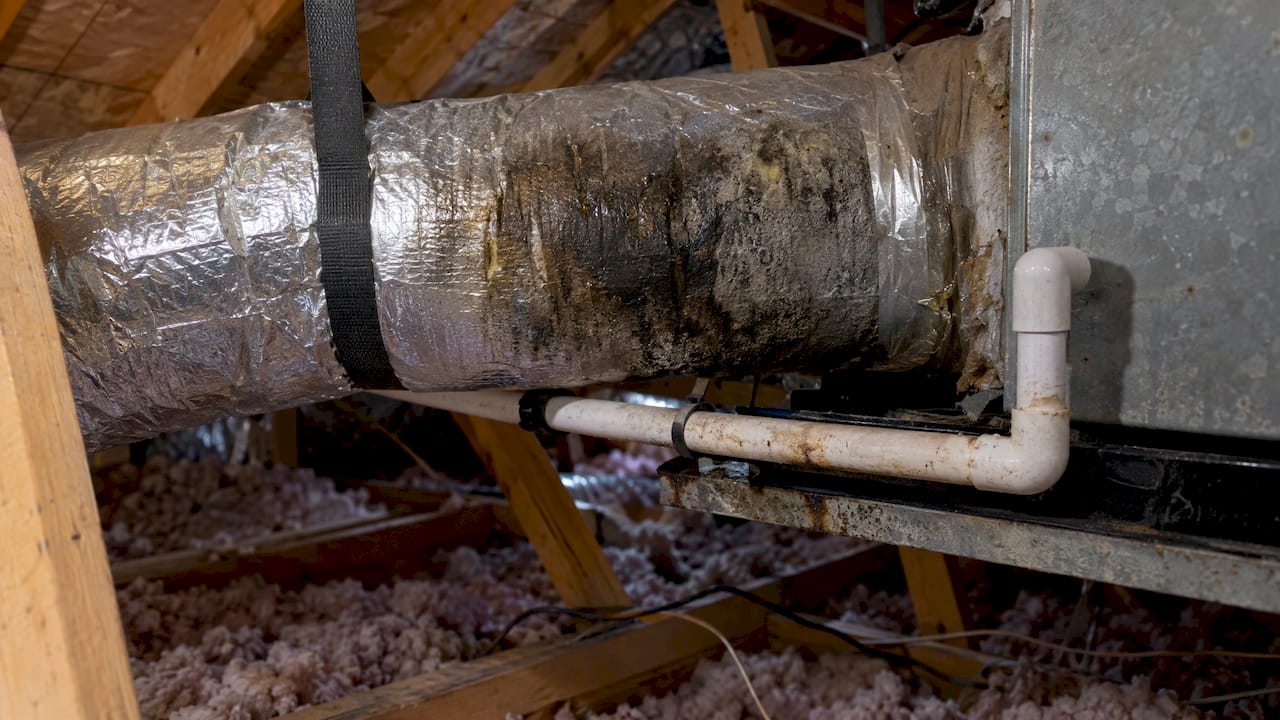
A failing air conditioner is a common Rio Grande Valley moisture source, since humid air and condensation sit together in the same system. A short dry cycle is one habit that helps stop mold building up in air conditioning units, and fixing a leaking drain line or a wet attic duct belongs in the same conversation as cleanup.
Do not cover it up
A bleach wipe and a coat of paint will not pass for remediation. Paint is part of a proper finish after cleanup, and the order matters: a checklist on painting over mold on walls shows what surface preparation belongs before any paint goes on. One mold specialist puts the danger bluntly, saying a bleach wipe and a fresh coat of paint is the option that comes back as a lawsuit, while an independent clearance report is what sells, per his published advice.
Keep the paper trail
After remediation, an independent third-party inspector can run a post-remediation clearance test and give written certification that indoor spore counts have returned to normal. In Texas, keep the remediation certificate too, since you may need to give it to the next buyer. Hand the file to the buyer with your disclosure.
Health: why mold is not just cosmetic
Safety comes before price. The EPA says molds produce allergens, irritants and in some cases potentially toxic substances, and that exposure may cause sneezing, a runny nose, red eyes and skin rash. People with asthma who are allergic to mold can have asthma attacks. If anyone living in the house has asthma, allergies or a weakened immune system, talk to their doctor about whether they should stay in the home during cleanup, and limit time near the affected area.
Our perspective
Most sellers who call us about mold are not worried about the mold alone. They are worried about the clock, the bills and the idea of strangers judging the house.
Our approach is built for that. We buy houses and land in Edinburg, TX for cash, in any condition: inherited, vacant, outdated, distressed or as-is. You do not clean, repair or stage anything. There is no agent and no commission. We evaluate the property against local market value and explain the offer plainly, and you pick the closing timeline, which can be as short as seven days.
You still tell us what you know about the mold and the water behind it. That keeps the sale clean and keeps everyone protected. Beyond that, we handle the paperwork and the closing, so a mold problem does not have to turn into months of waiting.
Wally
Selling to us instead of listing
If the numbers for remediation do not work, or you simply want the house off your hands, a direct sale is a clean exit. We make cash offers on houses in Edinburg, TX and handle the paperwork and closing. You choose the timeline.

Tell us about the property on our Edinburg cash offer page, or see how our process works first. Mold often arrives with other problems, and we also buy houses with foundation problems, inherited homes and houses that have sat on the market. If the mold is on vacant land or a lot with a damaged structure, see our page on selling land in Edinburg.
A practical checklist before you decide
- Find and stop the water source. A leak that keeps running makes every other step moot.
- Photograph what you see and note when you found it. This supports an honest disclosure.
- Estimate the affected area. Under about 10 square feet is a homeowner-sized job per the EPA; larger areas need professionals, and Texas licensing rules may apply.
- Get a remediation quote and, if the extent is unclear, an independent assessment from a different company than the one doing the cleanup.
- Compare the cost to the discount buyers might ask for, then compare both to a straight cash sale with no repairs.
- Disclose everything known, in writing, whichever route you pick.
FAQ
Can I sell a moldy house without fixing it?
Yes. You are not legally required to remediate before selling, but you must disclose what you know. As one real estate firm puts it, the law cares about what you disclose rather than whether you remediate. Selling as-is to a cash buyer is the simplest way to skip the repairs.
How much does mold lower a home’s value?
It varies with the extent and the buyer. One estimate puts average resale losses at 20% to 37% for minor and major problems. A documented, remediated and cleared house usually does better than one with unexplained stains.
Do I have to disclose mold I already cleaned up?
Generally yes. Sellers should disclose prior mold, the remediation done and any related repairs. In Texas, a remediation certificate issued in the past five years must be provided to the buyer.
Will a cash buyer take a house with mold?
Many cash buyers buy as-is, including homes with mold damage. We do: our purchases include distressed and as-is houses in Edinburg, TX, with no repairs or cleanup required from you.
Sources
- Can You Sell a House with Mold? (FastExpert)
- Can a Mold Infestation Decrease the Value of Your Home? (Angi)
- Mold Remediation Before Selling (Gladewick)
- Sell a House with Mold in California (LA Metro Home Finder)
- Texas Mold Disclosure (Mold Testing Houston)
- Legal Requirements for Mold Disclosure in Real Estate
- Florida Mold Disclosure Laws (Ilabaca Law)
- Philadelphia mold and moisture guide (Flagstone)
- Mold Statistics (Ruby Home)
- Selling a House With Mold: Disclose, Remediate, Credit (LookMold)
- Mold Assessors and Remediators FAQs (TDLR)
- Mold Cleanup in Your Home (US EPA)
- A Brief Guide to Mold, Moisture, and Your Home (US EPA)
- How do molds affect people? (US EPA)
- Requesting Repairs vs. Price Adjustments (ASHI)
- What Happens If a Home Inspection Finds Mold? (Donofrio)
- How to Handle Inspection Issues as a Seller in New York
- When You Might Need a Home Mold Inspection (Redfin)
- How Much Does a Mold Inspection Cost? (HomeLight)
- Selling a House With Mold, Asbestos, or Lead Paint (Effective Agents)
- Stop Aircon Mould with a Dry Cycle
- Checklist for Painting Over Mould on Walls