
Yes, you can usually sell a house that is in foreclosure, as long as you still hold the title and the foreclosure sale has not happened yet. The sooner you act, the more choices you keep. If the sale price covers your mortgage and costs, you walk away with whatever is left. If it doesn’t, the lender may agree to a short sale. After the auction, in most cases, it is too late.
This guide explains the stages, what the clock looks like in Texas, how to handle a sale that falls short of the loan, and where a fast cash sale fits.
TL;DR
- You can generally sell while you still own the home and before the foreclosure auction is complete. After the auction, title usually passes to the new buyer.
- Start with two numbers: your payoff quote from the servicer and a realistic market value. The gap tells you whether you will net money or need a short sale.
- In Texas, a nonjudicial foreclosure requires a notice of sale at least 21 days before the auction, so the window can be short.
- A short sale needs lender approval, and you should ask for a written waiver of any deficiency.
- A direct cash buyer can close on your timeline without repairs, showings or agent commissions, which matters when the deadline is close.
Table of Contents
- Can you sell a house that is in foreclosure?
- Judicial and nonjudicial foreclosure: why the state matters
- What the clock looks like in Texas
- Steps to sell before the auction
- Know your protections while you sell
- Who gets the money when the house sells?
- When the sale won’t cover the mortgage: short sales
- Taxes and credit after a short sale or deed in lieu
- Selling a foreclosed house as-is
- Traditional listing, short sale or cash sale?
- Selling your Edinburg house for cash
- Questions to ask any buyer before you sign
- FAQ
- Sources
Can you sell a house that is in foreclosure?
Yes. Your name stays on the deed until the foreclosure sale is completed and a new owner takes title, so you keep the legal right to sell. Nolo’s guide to selling before foreclosure explains that a sale that brings in enough money pays off the mortgage and protects the equity you have built. If the proceeds fall short, a lender-approved short sale may be needed. Once the property is auctioned, title generally transfers, though a few states give limited rights to buy it back afterward.
What changes from stage to stage is how much time and leverage you have:
| Stage | What it means | Your selling position |
|---|---|---|
| Missed payments | You are behind, but no legal action has begun | Most time. You can repair, clean, list and close normally |
| Notice of default or acceleration | The lender has formally started the process | Still workable, but the deadline is now on the calendar |
| Notice of sale | A sale date is set | Tight. Every week counts, and a buyer who can close fast matters |
| After the auction | A new owner holds title | Selling is generally off the table |
Nolo’s advice is to act before foreclosure starts, because that gives you the most time to repair, stage, market and close before the legal deadline.
Judicial and nonjudicial foreclosure: why the state matters
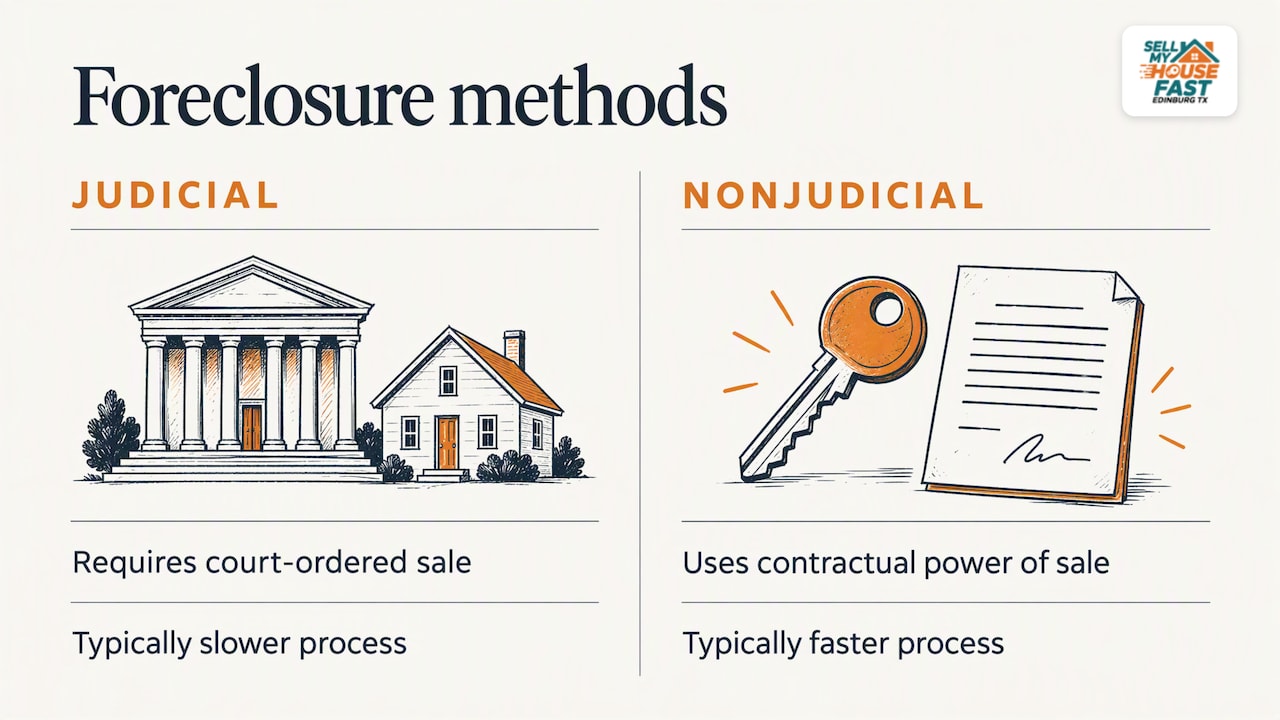
The speed of a foreclosure depends on where the house sits. Practical Law distinguishes judicial foreclosure, which requires a court-ordered sale and is typically slower and more expensive, from nonjudicial foreclosure, which uses a contractual power of sale and is typically faster. The National Association of REALTORS® likewise notes that foreclosure timelines vary widely by state, and that redemption rights differ too.
For reference, California’s courts explain that in a nonjudicial foreclosure there, a Notice of Default is followed after 90 days by a Notice of Sale. Other states have their own numbers. Never assume a rule you read about one state applies to yours.
What the clock looks like in Texas
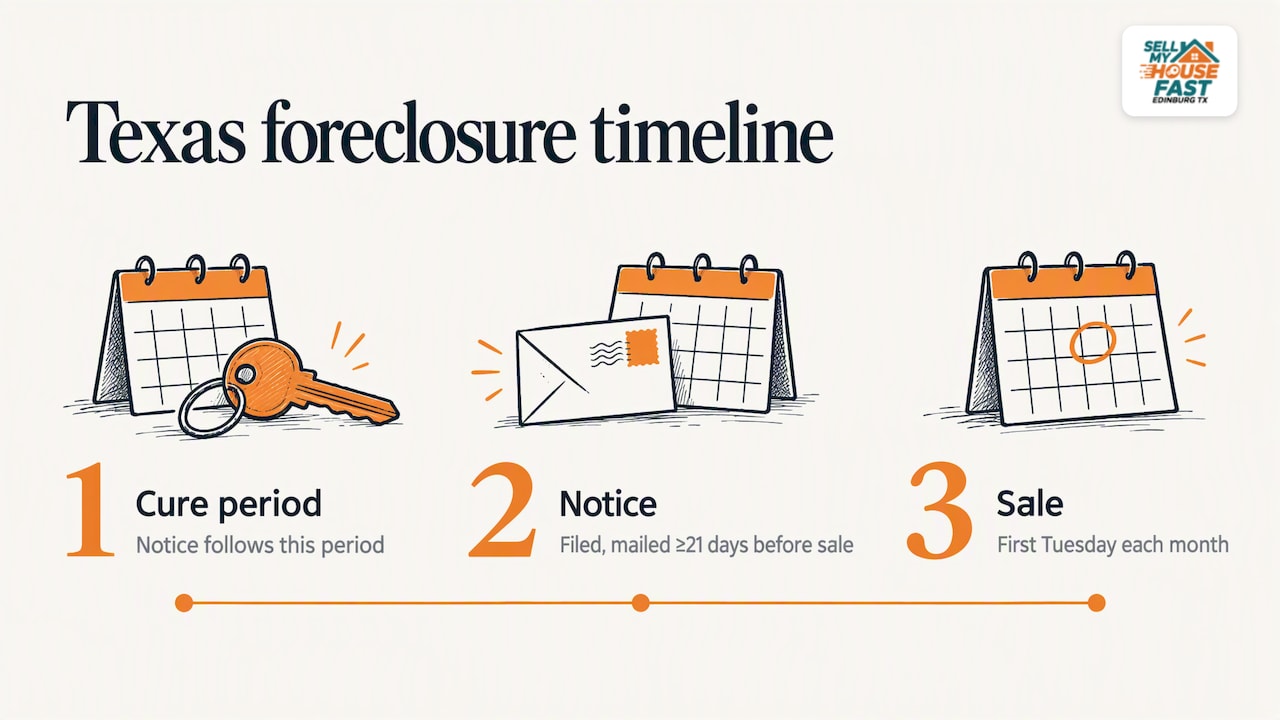
Most Texas home loans are secured by a deed of trust with a power of sale, so the typical path is nonjudicial. The Texas State Law Library states that this route requires a Notice of Sale at least 21 days before the sale, after the applicable cure period. A judicial foreclosure instead goes through a court judgment and an Order of Sale.
Texas sales happen on a set day each month. One Texas foreclosure law firm describes the legal floor this way: notice filed and mailed at least 21 days ahead, with the sale on the first Tuesday of a month. In practice that can mean only a few weeks between the notice and the auction, so a homeowner in Edinburg who receives a notice of sale should treat it as urgent.
If you are unsure which kind of foreclosure you face, your loan documents and the notice itself will say. A Texas real estate attorney or a HUD-approved housing counselor can read them with you.
Steps to sell before the auction
The order below keeps you from wasting days.
- Call your servicer and keep talking. Ask for a written payoff quote and the exact sale date. Nolo lists staying in contact with the servicer among the first steps.
- Estimate fair market value. Look at recent sales of similar homes nearby and be honest about the condition. A house that needs work sells for less than the same house in move-in shape.
- Total your costs. Add the payoff, back payments and fees, other liens, taxes owed and the costs of selling. If you are weighing a traditional listing, understand what agent pay looks like; this overview of real estate commission basics is a good place to see how those costs are built.
- Compare the numbers. If value minus costs is positive, you have equity to protect. If it’s negative, you are looking at a short sale.
- Choose your sale route. A traditional listing, a short sale or a direct cash sale each trade price against speed and certainty. The next sections compare them.
- Tell the servicer about a pending contract. The Georgia Attorney General’s office notes that a lender may postpone the sale when a contract is pending. Whether yours will is up to the lender and your loan terms, so ask early and get any postponement in writing.
If you also carry other debts, organizing them helps you see what you can pay from the sale. A simple debt payoff plan can show where proceeds should go first.
Know your protections while you sell
Federal servicing rules give some homeowners breathing room. The CFPB says its rules restrict dual tracking in covered cases, including a 120-day delinquency threshold before the first foreclosure filing and review protections for a complete loss mitigation application received at least 37 days before a scheduled sale. Those rules apply to covered loans and cases, so ask your servicer or a housing counselor whether yours qualifies.
The CFPB also lists repayment plans, forbearance, loan modification, short sale and deed in lieu as loss mitigation options, and says a HUD-approved housing counselor can help you understand the next steps. Applying for help and preparing a sale are not mutually exclusive. Run both until one works.
Who gets the money when the house sells?
In a normal sale during foreclosure, the closing agent pays the mortgage first, along with other liens, then the costs of the sale. Whatever remains is yours. The Georgia Attorney General explains that a conventional sale works when proceeds can cover the full loan balance and selling expenses, and that it lets you satisfy the mortgage, avoid lender-imposed late and legal fees, avoid credit damage and protect existing equity.
That is the main reason people sell instead of waiting: at an auction, the price is set by bidders on the courthouse steps, not by you, and fees keep stacking while the process runs.
When the sale won’t cover the mortgage: short sales
A short sale means selling for less than you owe. The CFPB describes it as a sale for less than the mortgage balance that requires lender approval. It is also a foreclosure alternative that requires you to leave the home.
Three things matter most:
- The lender decides. NAR’s workflow says a lender may ignore, reject, counter, ask the seller to contribute the shortfall, or approve. Approval concerns the terms and net proceeds of the deal, not just whether a buyer and seller agree.
- The leftover debt may not disappear. Where state law lets a lender collect a deficiency, the CFPB advises asking for a written deficiency waiver before you proceed. Washington’s financial regulator adds that a lender releasing its lien does not by itself mean the deficiency is forgiven. Get the waiver in the approval letter.
- Everything must be disclosed. The same Washington guidance says approval can require seller affidavits and that undisclosed seller proceeds, commissions or fees may be prohibited. Do not make side deals with a buyer.
Loan programs add their own rules. As one example, an FHA short sale at Bank of America can involve a hardship, an appraisal, a minimum price, broker listing deadlines and separate approval for any second lien. Short sales are legally sensitive, and NAR stresses involving qualified local attorneys and accountants. In Texas, that means someone who knows Texas foreclosure procedure.
Taxes and credit after a short sale or deed in lieu
Forgiven debt can carry a tax cost. The Georgia Attorney General’s guidance warns that forgiven debt in a short sale or deed in lieu may create tax liability, and that a deed in lieu can mean losing any equity. A deed in lieu may also be unavailable when you have other loans or liens on the property. Ask a tax professional before you sign anything that forgives part of the loan.
Selling a foreclosed house as-is
You do not have to fix everything before you sell. NAR points out that the owner still conveys title and remains responsible for ordinary disclosures, and that local law determines whether defects must be repaired or only disclosed. In plain terms: selling as-is is allowed, but you still tell the truth about the property’s condition.
This is where repair-heavy, inherited, vacant or outdated houses run into trouble on the open market. Traditional buyers want financing approvals, inspections and repair credits, and each step eats days you may not have. If you want to see how the numbers work, our guide on selling a house as-is and what you net walks through it.
Traditional listing, short sale or cash sale?
| Traditional listing | Short sale | Direct cash sale | |
|---|---|---|---|
| Best when | You have time and equity | You owe more than the house is worth | The deadline is close or the house needs work |
| Lender approval | Not needed if the payoff is covered | Required | Not needed if the payoff is covered |
| Repairs and showings | Usually expected | Usually expected | Not required of the seller |
| Agent commissions | Typically paid by the seller | Often involved | None with our process |
| Speed | Depends on market and buyer financing | Depends on lender response | The seller chooses the timeline |
If your house has been sitting without offers, it helps to know why. Our page on why a house won’t sell and what to do next covers the common causes.
Our perspective
We buy houses and land in Edinburg, TX, and the homeowners who call us about foreclosure share one thing: they are out of time and tired of waiting on other people. A traditional sale asks you to repair, clean, list, host showings and wait for a buyer’s financing to be approved. That works when the calendar is on your side. When a sale date is coming, it often isn’t.
Our approach is built for that moment. We make a cash offer based on local market value, there are no agent commissions or fees, you don’t repair or clean anything, and we handle the paperwork and closing. You pick the closing date that fits your situation, and we can close in as little as seven days.
We would rather you know your numbers first. Get your payoff quote, compare it to any offer you receive, and decide with clear eyes. If a cash sale pays off your loan and leaves you something, that can protect your credit and your equity. We say that plainly, and we explain every step so there are no surprises at the table.
Wally
Selling your Edinburg house for cash
If you own a house or land in Edinburg, TX and a foreclosure date is approaching, we can give you a straightforward cash offer. We buy inherited, vacant, outdated and distressed properties as they are, with no commissions and no fees, and you choose when to close.

You can see the steps on our how it works page, learn how to judge a fair cash offer, or request your cash offer now. Owners of vacant parcels can start at our land selling page.
Questions to ask any buyer before you sign
Whoever you sell to, a few questions protect you:
- Will the offer cover my full payoff, including fees and any other liens?
- Who pays closing costs, and are there any fees deducted from my proceeds?
- Can you close before the sale date, and can you put that in the contract?
- Who is the title company or closing attorney handling the funds?
- Is the offer in writing, with the price and closing date stated?
A serious buyer answers all of these without hesitation.
FAQ
Is it better to sell or let the house go to foreclosure?
If the sale will cover your mortgage and costs, selling is generally better. You avoid lender-imposed late and legal fees, protect your credit and keep any equity, as the Georgia Attorney General’s guidance explains. If you owe more than the house is worth, compare a short sale with the consequences of a foreclosure, which in some states can include a deficiency judgment, and talk to a HUD-approved housing counselor or attorney.
Can you sell a house that is being foreclosed on?
Yes, in most cases, while you still hold title and before the auction takes place. In Texas, a nonjudicial foreclosure requires a notice of sale at least 21 days before the auction, so the practical window can be short. Contact your servicer and get your payoff figure right away.
Who gets the money in a foreclosure sale?
When you sell the house yourself, the mortgage and other liens are paid first at closing, then the sale costs, and you keep what remains. If the property sells at a foreclosure auction, the proceeds go first to the debt and costs under the rules of your state. Ask the servicer or an attorney how that works for your loan.
Can I sell a foreclosed house as-is?
Yes. You do not have to finish every repair, but you still owe the disclosures your state and local law require. A cash buyer who purchases as-is can remove the repair and cleanup work, which saves time when a deadline is near.
Sources
- How to Sell Your House Before Foreclosure (Nolo)
- Residential Foreclosure Toolkit (Practical Law)
- The Short Sale Workflow (National Association of REALTORS®)
- Your rights in a nonjudicial foreclosure (California Courts)
- Before the Sale (Texas State Law Library)
- Texas Foreclosure Timeline
- Selling your Home (Georgia Attorney General, Consumer Protection Division)
- CFPB rules on foreclosure protections
- CFPB: help to prevent foreclosure
- What is a short sale? (CFPB)
- Short Sales: Guidance for Licensees (Washington DFI)
- FHA Short Sale (Bank of America)
- Real estate commission basics
- Debt payoff plan