
A fair cash offer is a price that reflects what your house is really worth in its current condition, is explained to you line by line, and comes with terms you can verify before you sign. It will usually be lower than what a fully repaired, listed home might fetch, because you are trading some price for speed, certainty and not having to fix or show the property. The goal is to make sure that trade is honest and that you know exactly what you are giving up.
This guide shows how cash buyers arrive at a number, how to test that number against your own, and which warning signs mean you should walk away. We buy houses and land in Edinburg, TX, so we point out what this looks like locally, but the checks apply to any cash offer.
TL;DR
- A fair cash offer starts from the home’s market value, then subtracts repairs and the buyer’s cost and risk. Expect it to be below a retail listing price.
- The only honest comparison is net proceeds: what you keep after commissions, repairs, carrying costs and closing costs in a traditional sale versus the cash offer.
- Ask for the offer in writing, with every deduction explained, and never pay a buyer anything before closing.
- Confirm whether the company will buy the house itself or plans to pass your contract to someone else.
- Use a title or escrow company to close, and verify wire instructions by phone.
Table of Contents
- What makes a cash offer fair and transparent
- How cash buyers calculate an offer
- Why cash offers are often lower than a listing price
- How to compare a cash offer with your net proceeds
- Timing is part of the price
- Red flags that suggest an offer is not fair
- Protect yourself at closing
- Our view on fair cash offers
- Get a cash offer for your Edinburg house or land
- FAQ
- Sources
What makes a cash offer fair and transparent
Fairness is not a single number. It is three things at once.
The price is anchored to evidence. The buyer can show you the recent sales of similar homes nearby and explain how your house differs from them. “Trust us” is not an explanation.
The adjustments are visible. If the buyer subtracts for a roof, foundation work, outdated systems or cleanout, you should see what was assumed and why. You can disagree with an estimate, but you should never be unable to see one.
The terms match the promise. No surprise fees at closing, no price that shrinks after an inspection without a clear reason, no pressure to sign today. The closing date, who pays closing costs and what happens to anything left in the house should all be on paper.
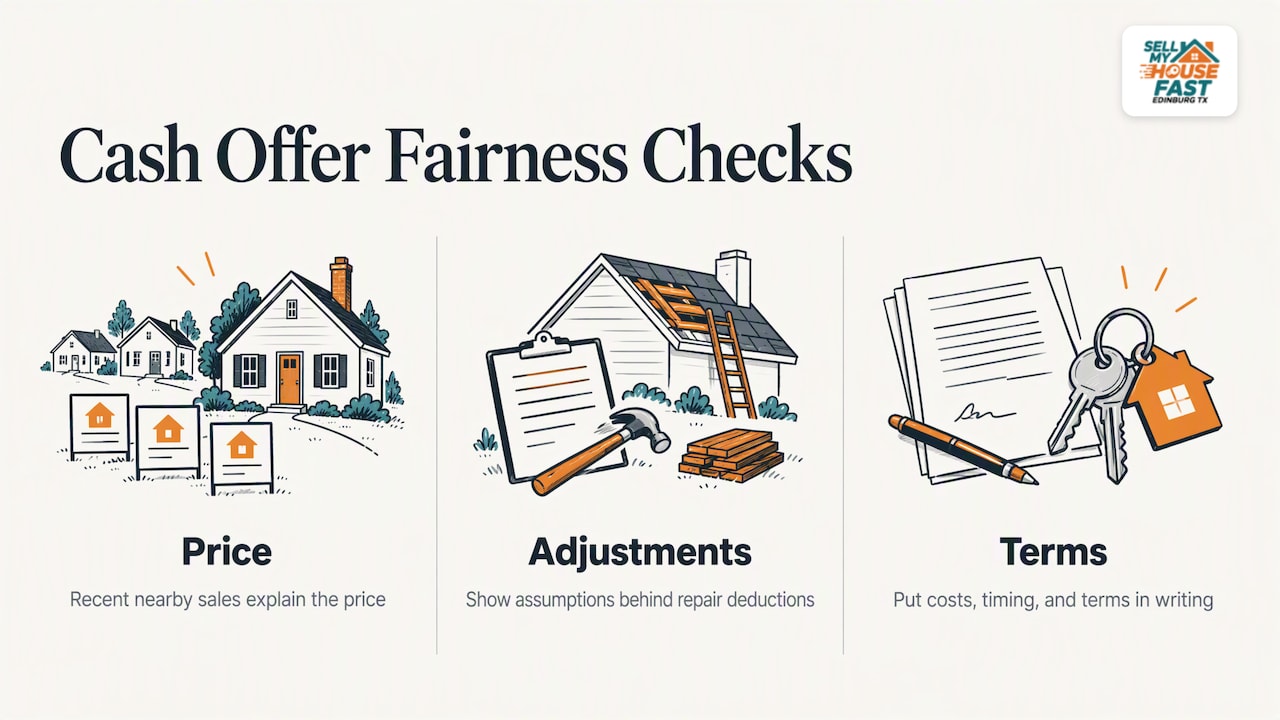
An offer can be low and still fair. An offer can also look high and be unfair, for example when it is padded and then reduced late in the process. Judge the process as much as the figure.
How cash buyers calculate an offer
There are different kinds of cash buyers, and they work out numbers differently.
The National Association of Realtors explains that direct buyers use algorithms and people to reach an approximate offer, then send someone to assess the home’s condition before setting the final figure. That final step is why a first estimate and a final offer can differ.
A local investor or house-buying company typically works backward from resale. In simple terms:
- Estimate what the house would sell for once repaired and updated, based on recent comparable sales.
- Subtract the cost of repairs and cleanup.
- Subtract holding costs, closing costs and a margin for the risk and effort of reselling.
Many investors use a percentage of that repaired value as a rule of thumb, and the percentage varies by buyer, market and property. What matters for you is that the formula has inputs you can check: the comparable sales and the repair estimate.
A worked example
The numbers below are hypothetical, only to show the logic. They are not a quote from us or a price for any Edinburg home.
| Item | Amount |
|---|---|
| Estimated value if repaired and updated | $200,000 |
| Estimated repairs and cleanout | $30,000 |
| Buyer’s holding, closing and resale costs, plus margin | $30,000 |
| Resulting cash offer | $140,000 |
Now compare it with a traditional sale of the same house, assuming you did not make repairs and had to sell as-is to a retail buyer who negotiates down:
| Item | Traditional sale | Cash sale |
|---|---|---|
| Sale price | $170,000 | $140,000 |
| Agent commissions | $10,200 | $0 |
| Seller closing costs | $3,400 | Often none to the seller, confirm in writing |
| Repairs you pay for | $10,000 | $0 |
| Months of mortgage, taxes, insurance, utilities | 4 months, about $6,000 | Close in days or weeks |
| What you keep | about $140,400 | $140,000 |
In this made-up case the two outcomes land close together, and the cash route is faster and certain. In another case, a clean, updated house in a hot market could net much more on the open market. The point is not that cash always wins. It is that you should do this arithmetic with your own figures before deciding.
Why cash offers are often lower than a listing price
Three reasons come up again and again.
First, the buyer is paying for convenience. NerdWallet notes that cash buyers may discount the price in return for convenience, and that investors may offer less because they hope to profit from the house, while a traditional cash buyer who plans to live in it expects a solid, move-in-ready property.
Second, the buyer takes on the work and the risk. NAR says direct buyers usually offer below the home’s traditional market price and may rent the property or refurbish and resell it. The gap partly pays for that work.
Third, emotion pays in a retail sale. The Better Business Bureau points out that traditional buyers may pay more for a home they have fallen in love with, while investors buy as an investment and will almost always offer less. If your house is dated, damaged, inherited and full of belongings, or vacant, few retail buyers will fall in love with it as it stands.

How to compare a cash offer with your net proceeds
A higher number on paper is not always the better deal. NAR’s guidance to sellers says those who prioritize a simpler transaction may prefer all-cash offers, and that the strongest offer may not be the one with the highest price. It also tells sellers to weigh price, financial terms, contingencies, closing timeline and earnest money, and to choose based on their own priorities.
Here is a practical way to do that.
- Get a realistic value. Ask a local agent for a comparative market analysis, or study recent sales of similar homes within a mile or so. Use sold prices, not asking prices.
- Price the repairs honestly. Get at least one contractor’s bid for anything major. Include cleanout and any code or permit issues.
- Add your carrying costs. Mortgage payments, property taxes, insurance and utilities for every month the house sits. If you are wondering why a home is not moving, our guide on why a house won’t sell and what to do next walks through it.
- Subtract the selling costs. Agent commissions, seller-paid closing costs and any concessions a buyer asks for.
- Compare the totals. Put the net figure from the traditional route beside the cash offer, then ask what your time and certainty are worth.
If you are weighing an as-is sale in general, how selling as-is works and what you net covers the trade-offs in more detail.
Timing is part of the price
Speed is the thing you are buying, so check what the buyer actually promises. The BBB says traditional sales may take several weeks, home investors can usually close in a month or less, and iBuyers can close in as little as a week.
If you must move by a certain date, for a job, a probate deadline or a foreclosure timeline, a short closing may be worth more than a few thousand dollars. If you have no rush, you have more leverage to ask for a better price or to list the house and see what the market says. A fair buyer will accept either decision without pressure. We let sellers choose their own timeline, and we can close in as little as seven days when that is what the seller needs.
Red flags that suggest an offer is not fair
- No explanation for the number. A buyer who cannot or will not walk you through comparables and repairs is hiding something or has not done the work.
- Pressure to decide today. Fair offers survive a night’s sleep and a second opinion.
- Fees that appear late. A promised “no fees” deal that sprouts charges at the closing table is not transparent.
- Requests for money up front. The BBB advises sellers to research the buyer, ask questions, avoid paying an investor before closing, and complete the transaction through a closing or escrow agent.
- A different buyer than the one you met. Some companies sign a contract and then pass it to another buyer. A guide from the site sellmyhouse.live suggests asking directly whether the company is the end buyer or intends to assign the contract, since that affects certainty. Ask it in plain words and get the answer in writing.
- A sale-leaseback dressed up as a cash offer. If the deal involves you renting your own home afterward, slow down. The FTC warned in 2024 that these arrangements can involve hidden fees, exorbitant rent, and eviction if you cannot afford rent increases, and it advises having a lawyer or a trusted person help review the contract.
What happens when “market value” claims are false
Big companies are not immune. In August 2022 the FTC charged that the iBuyer Opendoor made deceptive claims about paying market value and about repair costs, resulting in a $62 million settlement for refunds to affected sellers. The FTC said the offers were below market value and the repair deductions were higher than sellers would typically spend in a normal sale.
The lesson for any seller is to test two claims every time: “this is market value” and “your repairs cost this much.” Get your own bid for repairs. If storm damage to the roof is part of the discussion, it also helps to know how roofing scams after storms work, so an inflated repair figure from anyone does not go unchallenged.
Protect yourself at closing
The last step is where mistakes get expensive. The Consumer Financial Protection Bureau advises confirming payment details with trusted contacts using phone numbers you already have saved, and being wary of last-minute changes to wire instructions. Before you sign:
- Read the purchase contract fully, including who pays which costs and what the buyer can cancel for.
- Ask for the settlement statement ahead of closing and match it to the original offer.
- Close through a title company or attorney, and let them handle funds.
- Check that the title is clear. Inherited homes in particular may need probate or heirship documents before they can transfer, so ask early what paperwork will be needed.
- Keep copies of everything you sign.
Our view on fair cash offers
We are a local buyer in Edinburg, TX, and we make our money by buying houses and land below what they would bring on the open market, then reselling or investing. We say that plainly, because a seller who understands our business can judge our offer better. Pretending the discount does not exist is how trust gets lost.
What we think makes ours fair is the way it is built. We base the evaluation on local market value. We explain the figure. We do not charge commissions or fees, we do not ask you to repair or clean anything, and we handle the paperwork and closing. You choose the timeline. The house can be inherited, vacant, outdated or damaged, and it still gets a straight answer.
We also think you should not take our word for it. Get a second opinion. Run your own net proceeds. If a traditional listing would leave you better off and you have time to do it, we would rather tell you that than win a contract that does not serve you. A seller who signs knowing the trade-offs is a seller who has no regrets later.
— Wally
Get a cash offer for your Edinburg house or land
If you own a house in Edinburg, TX that needs work, came to you through an inheritance, or simply needs to sell on your schedule, we can give you a cash offer based on local market value, with no agent, commissions, repairs or cleanup on your side.
Request your cash offer and we will walk you through how we reached the number. You can read the step-by-step process first if you like. Own vacant acreage instead? See how we buy land in Edinburg, and if the property is a rental, our page on selling a rental property fast covers your options.
FAQ
How much lower is a cash offer than market value?
There is no single percentage, because it depends on the home’s condition, the repairs needed, the buyer’s costs and the local market. NAR says direct buyers usually offer below traditional market price, so expect a discount. Judge it by comparing net proceeds rather than the headline price alone.
Should I accept the first cash offer I receive?
Not automatically. Get the offer in writing with the deductions explained, compare it with your own estimate of value and repair costs, and consider at least one other opinion. A fair buyer will give you time to do that.
What are the risks of selling to a cash buyer?
The main ones are an offer that is unfairly low, fees or price changes late in the process, buyers who assign the contract to someone else, and payment or wire fraud at closing. You reduce them by researching the buyer, never paying before closing, using a title or escrow company and verifying payment details by phone.
Do I pay commissions or repair costs when I sell for cash?
With us, no. We do not charge commissions or fees, and you do not need to repair or clean up the property. With any buyer, confirm in writing who pays closing costs before you sign.
How quickly can a cash sale close?
The BBB says investors can usually close in a month or less. We can close in as little as seven days, or on a later date if that suits you better.
Sources
- Direct Buying, National Association of Realtors
- Should I Accept a Cash Offer for My House? NerdWallet
- BBB Tip: Selling your home for quick cash? Not so fast!
- Consumer Guide: Navigating Multiple Offers, NAR
- Closing the door on home buying company Opendoor’s false claims, FTC
- Risky business: offers to cash out your home equity through sale-leaseback, FTC
- Mortgage Closing Checklist, CFPB
- How to Choose a Cash Buyer for Your House
- Common Roofing Scams After Storms