
You can sell a rental property fast in three main ways: list it and push the timeline, auction it, or sell it directly for cash to a buyer who takes it as-is. Each one trades some price for speed, and the tenant, the lease and your tax bill decide how far you can push. This guide walks through the options, what happens to a lease when you sell, the tax questions to settle first, and how to check a cash offer before you sign.
TL;DR
- The fastest routes are an auction or a direct cash sale. A traditional listing with a vacant property usually brings the highest price but takes longest.
- In Texas, the buyer generally inherits the existing lease, so a tenant in place can’t simply be asked to leave for a sale.
- Depreciation you claimed on the rental is taxed when you sell, at up to 25%. Run the numbers with a tax professional before you accept any offer.
- A 1031 exchange can defer the tax, but its deadlines are strict and can clash with a very fast sale.
- Before accepting a cash offer, confirm the buyer’s proof of funds, who pays closing costs, and the closing date in writing.
Table of Contents
- The main ways to sell a rental quickly
- What happens to your tenant and the lease
- Taxes: the part that can change your answer
- Selling a rental that needs repairs or is sold as-is
- Inherited or distressed rentals: what to weigh first
- How selling a rental for cash works
- Our perspective
- Selling your Edinburg rental to us
- A practical timeline for a fast sale
- FAQ
- Sources
The main ways to sell a rental quickly
There is no single “fast” route. There are a few, and each costs you something different.
| Route | Speed | Price | Main catch |
|---|---|---|---|
| List vacant with an agent | Slowest | Usually highest | Carrying costs while empty, repairs and showings |
| List with tenants in place | Medium | Often lower | Tenant cooperation, lease terms |
| Auction | Fast | Buyers expect a discount | Fees, as-is terms, less control over final price |
| Direct cash sale | Fastest | Below full retail | You give up the retail premium for certainty |
The first two are the traditional route. Zillow’s guide to selling with tenants explains the central choice. Waiting for the lease to end lets you clean and make cosmetic updates that may lift the price, but you keep paying the mortgage and other carrying costs meanwhile. Selling occupied can serve as built-in staging and appeal to investors, but tenants who don’t cooperate make showings hard.
Auctions are the next step up in speed. They concentrate showings on set dates and create urgency, but the property is sold as-is and buyers bid expecting a bargain.
A direct cash sale is the quickest and the simplest. There is no listing, no showings and no buyer financing to fall through. The trade-off is plain: you accept a price below what a perfectly prepared, vacant house might fetch in a long marketing period, and in return you get certainty and control of the date.
How to decide which route fits
Start with three questions.
- What does waiting cost you each month? Add the mortgage payment, taxes, insurance, repairs and any vacancy. If that number is large, a lower price that closes in weeks can beat a higher price that closes in months.
- What condition is the property in? A rental with deferred maintenance, a damaged unit or a difficult tenant is hard to sell at retail. Buyers on a traditional listing will ask for inspections and repairs.
- How firm is your deadline? A probate timeline, a foreclosure notice, a job relocation or a partner buyout all push you toward certainty over price.
If the house is clean, vacant and the market is moving, a traditional listing may serve you well. If it is tired, occupied, inherited or draining cash, the faster routes make more sense.
What happens to your tenant and the lease
This is where many landlords lose weeks. A sale does not cancel a lease.
In Texas, the State Law Library explains that the new owner is bound by the existing lease unless the lease itself says it ends on sale. Otherwise the new owner can’t remove the tenant or change the lease during its term. Read your lease for any sale clause before you plan around a vacant closing.
That has practical effects:
- A tenant on a long lease limits your buyer pool. Investors may like the existing rent. Buyers who want to live in the house will pass until the lease expires.
- Showings depend on the lease. According to Zillow, whether you can show the property while tenants live there depends on the lease agreement, and state rules also affect whether tenants can leave in time for a sale.
- Month-to-month tenancies are more flexible, but you still have to follow your state’s notice rules. Check them before you promise a buyer a vacant closing date.
Whatever route you choose, assemble the paperwork a buyer will ask for. A rental sale checklist recommends the signed lease and addenda, the rent ledger, a written accounting of the security deposit, and dated condition records. Having these ready removes a common source of delay.
Treat your tenant as a partner, not an obstacle. A tenant who pays on time and knows the plan is more likely to allow a quick walkthrough, which keeps an inspection or an appraisal on schedule.
Taxes: the part that can change your answer
Speed is worth little if you misjudge the tax bill. We are not tax advisers, and your situation will differ, so use this section to prepare questions for a CPA or tax attorney.
Gain, basis and depreciation
For U.S. owners, IRS Publication 544 says gain or loss is generally the amount you realize minus your adjusted basis. Depreciation lowers that basis. For property used partly for rental, depreciation you took, or could have taken, is subtracted from basis. A lower basis means a bigger taxable gain.
There is a second layer. According to IRS Publication 523, depreciation previously claimed on a rental must be “recaptured” at sale and taxed as ordinary income at a rate of up to 25%. Many landlords are surprised by this because they think of the sale only in terms of long-term capital gains rates. Confirm the current rules with your tax professional, because that publication is from the 2022 tax year.
This is why “I paid $140,000 and sold for $190,000” is not the whole calculation. Improvements add to basis, depreciation reduces it, and selling costs reduce your gain.
Deferring the tax with a 1031 exchange
A like-kind exchange can defer tax on investment real estate if you reinvest in another investment property. The rules are rigid. According to a 1031 guide from a law firm, you must identify replacement property in writing within 45 days of the sale and complete the purchase within 180 days. You also need a qualified intermediary and cannot take possession of the sale proceeds.
Two things matter if you want speed:
- Set up the intermediary before you sign, not after closing. Once the money touches your account, the deferral can be lost.
- A very fast sale does not shorten your replacement deadlines, so line up your next property early.
A 1031 exchange suits an investor staying in real estate. If you want out entirely because of fatigue, a death in the family or a cash crunch, it is probably not your path, and the tax is a cost you plan for.
Costs that reduce what you keep
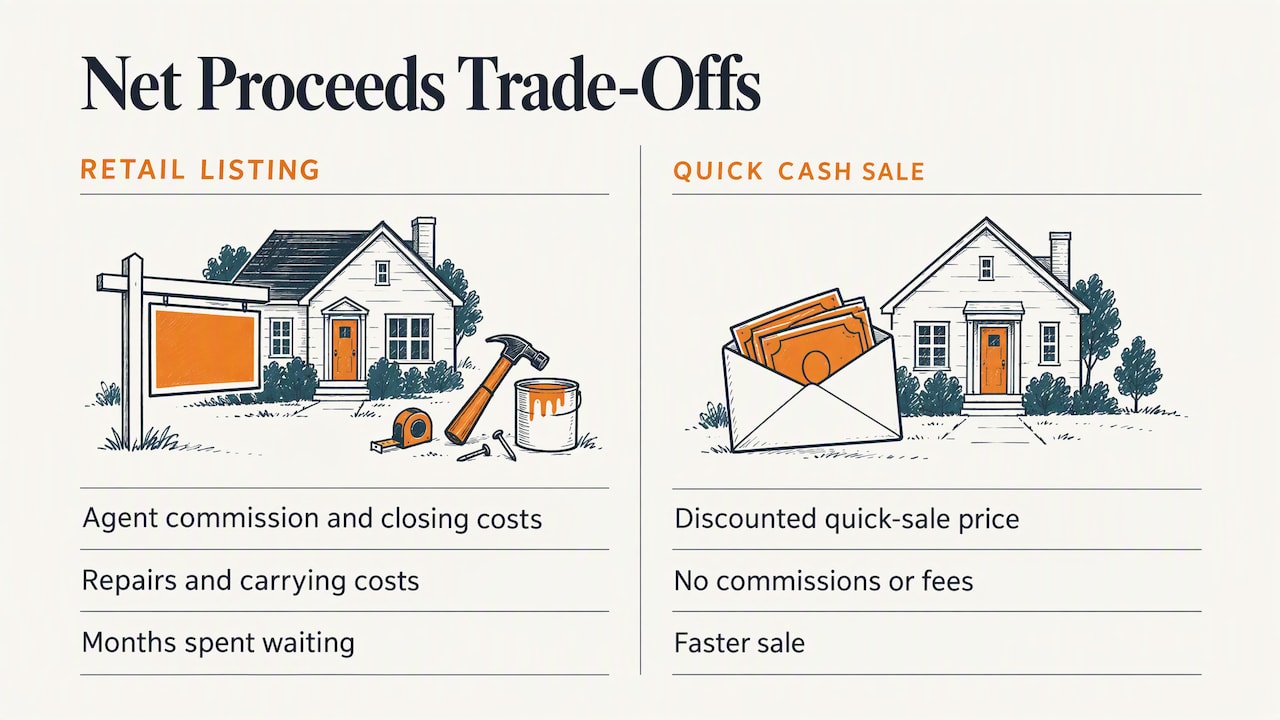
The usual deductions from your sale proceeds are agent commissions, closing costs and any repairs you make. A cash buyer that charges no commissions or fees can change that math. Compare net proceeds, not headline prices, between a discounted quick sale and a retail listing after commissions, repairs, carrying costs and months of waiting.
Selling a rental that needs repairs or is sold as-is
Most landlords who need speed also have a property that isn’t showroom-ready. The standard advice is pragmatic.
Zillow’s as-is guidance says to price against recent sales of similar homes in the area. If you do make improvements, put major systems first: roof, electrical, water, mold, HVAC and plumbing. Cosmetic fixes come after. If you sell as-is, disclose what a pre-inspection finds, describe the condition plainly and aim at investors, flippers and fixer-upper buyers. Zillow also notes that you’ll likely accept a lower price.
The key question is whether a repair pays back faster than it delays you. A $6,000 bathroom refresh that adds $4,000 to the price and takes two months is a loss when you are paying carrying costs. Skipping repairs often wins when:
- the work is extensive, not cosmetic;
- a tenant is still living in the unit;
- you don’t have cash to front the work;
- the buyer is an investor who will renovate anyway.
Disclose honestly. Texas sellers of many residential properties have statutory disclosure duties, so check the requirements for your property type with a real estate attorney or title company before you list or sign.
Inherited or distressed rentals: what to weigh first
A rental that came through an estate, or one that is behind on payments, carries pressures a normal sale doesn’t.
Inherited rentals. Heirs often face shared ownership, a tenant they’ve never met, unpaid taxes and a house nobody wants to maintain. Before choosing a quick sale, make sure the title is clear and all owners agree. Ask a tax professional how your basis in an inherited property is set, because it can differ from the original owner’s. That can change the tax picture of a sale entirely.
Financially distressed rentals. If you’re behind on the mortgage, talk to your lender early about options, and speak to a housing counselor or attorney if foreclosure has started. A fast sale can pay off the loan and stop the damage to your credit, but only if the offer covers your payoff. Ask your lender for a payoff figure before comparing offers.
Landlord fatigue. Plenty of owners simply want out after bad tenants, repairs and rising costs. That is a legitimate reason to choose speed, as long as you’ve compared net proceeds.
How selling a rental for cash works
A direct sale to a cash buyer is the shortest path from decision to closing. The steps look like this:
- Share the basics. Address, condition, whether it is occupied, and your timeline.
- Get an evaluation. A legitimate buyer looks at local values and the condition and gives you a number, with no obligation.
- Review the offer in writing. Check the price, closing costs, closing date and any contingencies.
- Open escrow with a title company. The title company checks ownership and liens and handles the paperwork.
- Close and get paid. You choose a closing date that works for you, within what the buyer can do.
What to verify before you accept
Not every “we buy houses” offer is the same. Ask these questions:
- Proof of funds. Can the buyer show cash, or is it relying on financing or on reselling your contract to someone else?
- Contingencies. Is the offer conditional on inspections, financing or an unspecified “approval”? Each contingency is a way for the price to drop late.
- Who pays what. Ask for closing costs, title fees and any commissions in writing.
- Tenant handling. Does the buyer take the property with the tenant in place, as the lease requires, or expect it vacant?
- The closing company. Use a reputable title company and read the contract, or have an attorney read it.
- No pressure. A legitimate buyer lets you compare offers. Be careful with anyone demanding an immediate signature or an upfront fee from you.
Our perspective
We buy houses and land directly in Edinburg, TX, and we hear the same story from landlords again and again: the property started as an investment and turned into a weight. A tenant moved out and left damage. An inherited duplex sits half empty. The repair bill is bigger than the equity feels worth.
In those moments, price is not the only number that matters. The months of mortgage payments, taxes, insurance and worry have a cost too, and a retail listing hides them. We would rather you compare the whole picture than chase the highest headline offer.
We don’t believe a cash sale is right for everyone. If your house is clean, vacant and you have time, a traditional listing may bring more. If it needs work, has complicated ownership or you need certainty, a direct sale removes the realtor fees, the showings and the waiting on a buyer’s approval. We make an offer based on local market values, handle the paperwork and closing, and let you choose the timeline. Some sales can close in as little as seven days, but only when you want that pace.
Whatever you decide, get the tax questions answered first and every number in writing.
— Wally
Selling your Edinburg rental to us
If your rental is in Edinburg, TX, we buy as-is: no repairs, no cleanup, no agent and no commissions or fees. Tell us about the property, whether it’s occupied and when you’d like to close, and we’ll give you a fair cash offer based on local values. You can see the steps on how our process works, or request your cash offer directly. If what you own is vacant ground, we also buy land in Edinburg.
A practical timeline for a fast sale
Whatever route you take, work in this order to avoid the delays that cost the most.
- Week 1: gather facts. Pull your lease, rent ledger, deposit accounting, mortgage payoff figure and last year’s tax return showing depreciation.
- Week 1: talk to a tax professional. Ask about recapture, basis and whether a 1031 exchange is worth it for you.
- Week 1 to 2: tell your tenant. Be clear about what the sale means under the lease. Under Texas guidance, a tenant generally stays through the lease term.
- Week 2: collect offers. Compare net proceeds across a listing, an auction and a cash sale.
- Week 2 to 4: contract and title. Read the contract, confirm the closing date and who pays which costs.
- Closing. Transfer the security deposit and records as the contract requires.
The weeks are a planning guide, not a promise. A clear title and a cooperative tenant shorten them. Liens, a missing co-owner or a dispute lengthen them.
FAQ
What is the fastest way to sell a rental property?
A direct cash sale is generally the fastest, because there is no listing, no showings and no buyer financing to wait on. Auctions are the next fastest. Both usually mean accepting a price below what a long retail marketing period might bring, so compare net proceeds first.
Can I sell a rental property with a tenant living in it?
Yes. In Texas the new owner generally takes over the existing lease, so the tenant can usually stay through the lease term unless the lease says it ends on sale. Investors often buy occupied rentals. Buyers who want to move in will wait for a vacant house.
How do I avoid capital gains tax when selling a rental property?
There is no simple way to avoid it. A 1031 exchange can defer the tax if you reinvest in another investment property within strict deadlines, and depreciation recapture can apply to the sale. Speak with a CPA or tax attorney before you accept an offer.
Do I need to make repairs before selling fast?
Not if you sell as-is to a buyer who plans to renovate. Repairs only make sense if they pay back more than the time and carrying costs they add. Major systems like the roof, HVAC and plumbing matter most if you do fix something.
Sources
- Selling a Property with Tenants, Zillow
- How to Sell a House As-Is When it Needs Repairs, Zillow
- My landlord sold the property: new owner and the lease, Texas State Law Library
- Selling a Rental Property With Tenants guide, Discovery Mark
- IRS Publication 544 (2024)
- IRS Publication 523 (2022)
- 1031 Exchange Rules: Timelines, Traps, and How to Qualify, Pease Bell